Building a Modern SQL Server DBA Toolkit: From Reactive Support to Proactive Mastery
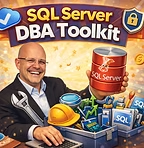
In today’s data-driven world, the role of a SQL Server professional has evolved far beyond routine maintenance and troubleshooting. Whether you are a Database Administrator (DBA), developer, or IT infrastructure specialist, your effectiveness increasingly depends on your ability to anticipate problems, optimize performance, and automate operations.
This transformation requires more than theoretical knowledge—it demands a practical, well-equipped toolkit. A toolkit that empowers you to monitor, analyze, stress test, and automate your SQL Server environments with precision and confidence.
This is exactly where a structured, hands-on approach to building a DBA toolkit becomes invaluable.
The Shift from Reactive to Proactive Database Management
Traditionally, many professionals operate in a reactive mode: responding to slow queries, outages, or user complaints after they occur. However, modern environments require a proactive stance.
A well-prepared DBA should be able to:
- Detect performance degradation before it impacts users
- Simulate workloads to predict bottlenecks
- Analyze queries with precision and clarity
- Automate repetitive administrative tasks
- Maintain full visibility into system health
Achieving this level of control is only possible with the right combination of tools and methodologies.
Monitoring with Precision: The Power of DBADash
One of the cornerstones of effective database management is comprehensive monitoring. Without visibility, optimization becomes guesswork.
DBADash stands out as a powerful, free solution that provides:
- Centralized dashboards for multiple SQL Server instances
- Real-time insights into performance and health
- Historical data for trend analysis
- Easy identification of bottlenecks and anomalies
By leveraging such tools, professionals move from fragmented monitoring to a unified, data-driven perspective of their environment.
Stress Testing: Understanding Behavior Under Pressure
Performance issues often emerge under load—not during normal operation. This is why stress testing is critical.
Tools like SqlQueryStress allow you to:
- Simulate concurrent workloads
- Reproduce real-world usage scenarios
- Identify locking, blocking, and resource contention
- Validate scalability before deployment
Instead of waiting for production failures, you gain the ability to predict and prevent them.
Deep Query Analysis: Turning Metrics into Decisions
Understanding query performance is not just about execution time—it requires analyzing multiple dimensions, including:
- CPU consumption
- Logical and physical reads (I/O)
- Execution plans
- Wait statistics
By using tools like Statistics Parse, professionals can break down complex queries and make evidence-based optimization decisions.
This analytical capability separates average practitioners from true performance experts.
Automation and Efficiency with PowerShell and DBATools
Manual administration is not scalable. As environments grow, automation becomes essential.
DBATools and PowerShell scripts provide a powerful ecosystem for:
- Automating routine administrative tasks
- Managing SQL Server instances at scale
- Deploying updates such as Cumulative Updates (CUs)
- Standardizing processes across environments
Automation not only saves time—it reduces human error and ensures consistency, which is critical in enterprise systems.
Learning from Industry Leaders: Proven Scripts and Practices
A strong DBA toolkit is not built in isolation. It is shaped by the collective expertise of the SQL Server community.
Renowned experts such as:
- Brent Ozar
- Adam Machanic
- Ola Hallengren
have developed scripts and methodologies that are widely adopted across the industry.
By incorporating these tools into your workflow, you gain access to battle-tested solutions used by top professionals worldwide.
Bridging Theory and Practice
One of the biggest challenges in learning SQL Server performance tuning is the gap between theory and real-world application.
A practical approach focuses on:
- Real tools used in production environments
- Hands-on exercises rather than abstract concepts
- Solving actual performance problems
- Building reusable scripts and workflows
This approach ensures that learning translates directly into measurable improvements in your daily work.
Who Benefits from Building a DBA Toolkit?
This type of skillset is valuable across multiple roles:
- Beginner DBAs seeking a strong foundation
- Experienced DBAs aiming to modernize their workflow
- IT infrastructure teams managing complex environments
- Developers who need deeper insight into query performance
- Professionals focused on solving real performance challenges
Regardless of your starting point, mastering these tools equips you to operate with confidence, efficiency, and technical depth.
Final Thoughts: Elevating Your SQL Server Expertise
The difference between a good SQL Server professional and a great one lies in tool mastery, practical experience, and proactive thinking.
By building a comprehensive DBA toolkit, you:
- Gain full control over your environment
- Improve system reliability and performance
- Reduce downtime and operational risk
- Increase your value as a technical professional
This is not just about learning tools—it’s about transforming how you approach database management.
🎓 Course Recommendation
To dive deeper and build your own professional toolkit step by step, you can explore the course:
👉 https://www.udemy.com/course/sql-server-dba-toolkit/?couponCode=9901C18D571B3DB1348D
Share this content:


Post Comment