Statistics in SQL Server: The Silent Force Behind Performance (And Why DBAs Ignore It at Their Own Risk)
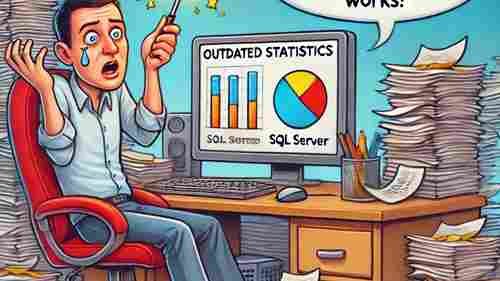
Let me tell you something that many professionals underestimate:
Indexes are powerful.
Hardware is expensive.
But statistics decide everything.
If you don’t understand statistics in SQL Server, you are not really tuning performance — you’re guessing.
And guessing in production is dangerous.
What Statistics Really Are (And Why They Matter More Than You Think)
In SQL Server, statistics are objects that store information about data distribution in columns or indexes.
They tell the optimizer:
- How many rows exist
- How values are distributed
- How selective a column is
- How many rows are likely to match a filter
- Whether a join will return 10 rows or 10 million
And based on that… the optimizer chooses the execution plan.
Not you.
The statistics do.
The Optimizer Is Smart — But Only As Smart As Its Data
SQL Server’s optimizer is cost-based.
That means it doesn’t test every possible execution plan.
It estimates.
And those estimates are based on statistics.
If statistics are outdated or inaccurate:
- Cardinality estimates become wrong
- Memory grants become incorrect
- Join strategies become inefficient
- Parallelism decisions become suboptimal
- Execution plans degrade
A single bad estimate can cause:
- Table scans instead of index seeks
- Hash joins instead of nested loops
- TempDB spills
- Excessive CPU usage
- Blocking chains
- Massive I/O spikes
And then people blame SQL Server.
But the real problem?
Bad statistics.
Automatic Statistics Update: Good, But Not Always Enough
SQL Server updates statistics automatically.
By default, when approximately 20% of rows change (plus a small threshold), statistics are updated.
That sounds good.
But let’s be honest.
On a table with 500 million rows, 20% means:
100 million row changes.
You’re telling me you want to wait for 100 million changes before updating stats?
In large enterprise systems, that’s unacceptable.
Automatic updates are helpful.
But they are not a strategy.
They are a safety net.
When FULLSCAN Makes a Difference
By default, SQL Server often samples data when updating statistics.
Sampling works well in many scenarios.
But not when:
- Data is highly skewed
- Distribution changed significantly
- Large bulk loads occurred
- You migrated historical data
- You rebuilt data partitions
- Query performance suddenly degraded
That’s where:
UPDATE STATISTICS TableName StatisticName WITH FULLSCAN;
Makes a difference.
FULLSCAN forces SQL Server to read 100% of rows.
It builds a precise histogram.
It gives the optimizer real visibility.
Yes, it costs more I/O during execution.
But it may save hours of bad performance.
Real-World Experience: When Statistics Destroyed a System
I’ve seen systems where:
- CPU was constantly at 95%
- Queries were timing out
- Blocking was everywhere
- Indexes were rebuilt daily
- Hardware was upgraded twice
And the root cause?
Outdated statistics.
After a proper statistics maintenance strategy:
- CPU dropped dramatically
- Query duration stabilized
- Execution plans normalized
- No hardware upgrade needed
Sometimes the cheapest fix is the smartest one.
The DBA’s Responsibility: You Cannot Delegate This
Statistics management is not just a maintenance task.
It’s a performance governance strategy.
A mature DBA should:
- Monitor statistics modification counters
- Track last updated timestamps
- Identify skewed data distributions
- Detect sudden plan regressions
- Integrate stats maintenance into job schedules
- Treat statistics differently for large vs small tables
Blindly running:
EXEC sp_updatestats;
Is not a strategy.
It’s laziness.
Parameter Sniffing and Statistics: The Dangerous Combination
Now let’s talk about something advanced.
Statistics interact directly with parameter sniffing.
When a stored procedure compiles:
- It uses statistics
- It builds an execution plan
- It caches the plan
If statistics don’t reflect reality:
The wrong plan may be reused for different parameter values.
And suddenly:
- A query that runs in 100ms takes 30 seconds
- Memory grants explode
- TempDB starts spilling
This is not just about updating stats.
It’s about understanding plan stability.
Large Tables Need Different Rules
In high-volume systems:
- Hundreds of millions or billions of rows
- Heavy insert activity
- Frequent data changes
Statistics maintenance must be:
- Targeted
- Scheduled intelligently
- Partition-aware
- Possibly incremental (if using partitioned tables)
You cannot treat a 10,000-row table and a 2-billion-row table the same way.
That’s junior thinking.
Sampling vs FULLSCAN: Strategic Decision
FULLSCAN is not always required.
But you must evaluate:
- Is the data skewed?
- Is the column critical for filtering?
- Are execution plans unstable?
- Has distribution drastically changed?
If yes — FULLSCAN may be justified.
If not — sampling might be enough.
A DBA must know the difference.
Statistics and the Bigger Maintenance Picture
Statistics do not live alone.
They are part of:
- Index maintenance strategy
- Query tuning strategy
- Plan cache monitoring
- Partition management
- Performance baselining
You cannot optimize performance if you ignore statistics.
And you cannot claim to be a performance specialist if you don’t understand histograms.
Global Perspective: Why This Matters Everywhere
Whether you work in:
- North America
- Europe
- Asia
- Latin America
- Enterprise
- Startup
- Cloud
- On-prem
Statistics matter.
Because the engine works the same.
And performance problems are universal.
Modern environments with:
- Azure SQL
- Amazon RDS for SQL Server
- Managed Instances
Still depend on statistics.
Cloud did not remove this responsibility.
It only made performance more expensive.
Final Thoughts
Statistics are invisible.
They don’t appear in dashboards.
They don’t generate alerts.
They don’t send emails.
But they silently control every execution plan.
If you ignore them, you will:
- Fight performance fires forever
- Waste hardware money
- Blame the engine incorrectly
If you master them, you gain:
- Predictable performance
- Plan stability
- Lower CPU usage
- Better scalability
- Technical credibility
Statistics are not glamorous.
But they separate average DBAs from elite ones.
And in today’s world, being average is not enough.
🚀 Ready to boost your career in data?
👉 DBAcademy – DBA & Data Analyst Training
Over 1,300 lessons and 412 hours of exclusive content.
Includes subtitles in English, Spanish, and French.
🔗 https://filiado.wixsite.com/dbacademy
💡 Start learning today and become a highly in-demand data professional.
Share this content:


Post Comment