Microservices and Their Real Impact on Databases: Architecture, Trade-Offs, and the DBA’s New Reality
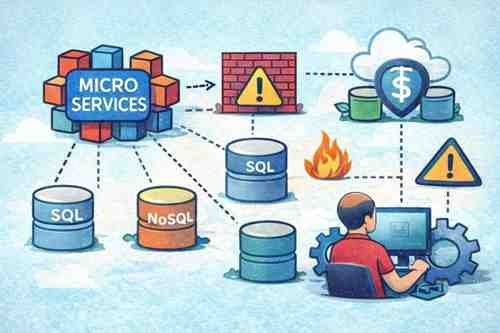
Over the past decade, microservices have gone from trend to mainstream architecture.
Every company wants scalability.
Every company wants resilience.
Every company wants independent deployments.
And microservices promise all of that.
But here’s what many teams underestimate:
Microservices dramatically change the database layer.
And that change is not trivial.
What Microservices Really Mean (Beyond the Buzzword)
At its core, microservices architecture breaks a monolithic system into independent services, each responsible for a specific business capability.
Each service:
- Has its own lifecycle.
- Can be deployed independently.
- Scales independently.
- Often owns its own database.
That last point is where things get serious.
In traditional monolithic architectures, you typically have:
One database.
One schema.
One centralized transactional boundary.
In microservices?
You have distributed data ownership.
And distributed data introduces distributed complexity.
The “Database per Service” Principle
One of the foundational principles of microservices is:
Each service must own its data.
This avoids tight coupling between services.
But it also eliminates something that DBAs have relied on for decades:
Centralized relational integrity.
No more global foreign keys.
No more cross-schema joins.
No more simple ACID transactions across modules.
You trade simplicity for autonomy.
The Advantages — And They Are Real
Let’s be fair. Microservices bring real benefits.
1. Independent Scalability
If your payment service receives heavy traffic, you can scale:
- Its application layer.
- Its database.
- Its infrastructure.
Without affecting reporting, authentication, or inventory services.
That’s powerful.
2. Fault Isolation
If one service fails, it doesn’t necessarily bring the entire system down.
In database terms:
A deadlock storm or blocking issue in one service database won’t directly freeze others.
That isolation increases resilience.
3. Technological Flexibility
One service may use SQL Server.
Another may use PostgreSQL.
Another may use MongoDB.
Polyglot persistence becomes possible.
You choose the right tool for each workload.
But this flexibility comes with governance challenges.
4. Faster Deployment Cycles
Smaller services.
Smaller schemas.
More focused change sets.
Continuous delivery becomes easier.
Now Let’s Talk About the Hard Part
Microservices do not eliminate complexity.
They relocate it.
From inside the database…
To between services.
The Biggest Challenge: Distributed Transactions
In a monolith, a single ACID transaction can update:
Orders.
Payments.
Inventory.
Customers.
Commit once.
Rollback once.
In microservices?
Each service has its own database.
So how do you guarantee consistency?
You don’t use traditional distributed transactions lightly.
MSDTC in SQL Server?
Technically possible.
Architecturally discouraged in microservices.
Because:
- It introduces latency.
- It increases coupling.
- It reduces scalability.
- It complicates failure recovery.
Instead, modern architectures rely on:
- Event-driven patterns.
- Eventual consistency.
- Sagas (orchestration/choreography).
- Compensation logic.
That’s a paradigm shift for DBAs.
Eventual Consistency: A Cultural Shock for Relational Minds
Traditional DBAs think in:
Strong consistency.
Immediate referential integrity.
Transactional atomicity.
Microservices often accept:
Temporary inconsistency.
For example:
An order is created.
Payment confirmation arrives seconds later.
Inventory adjusts asynchronously.
There may be a small window where data is not perfectly aligned.
That’s acceptable in distributed systems.
But it requires business alignment.
Data Fragmentation and Reporting Complexity
Another hidden challenge:
When each service owns its data, reporting becomes harder.
You can’t just write:
SELECT * FROM Orders JOIN Customers JOIN Payments
Across databases.
Now you need:
- Data replication
- Event streaming
- Data warehouses
- API aggregation layers
This increases architectural overhead.
Microservices simplify deployment — but complicate analytics.
Operational Explosion
From a DBA operational perspective, microservices multiply responsibilities.
Instead of managing:
1 large database.
You may manage:
10, 20, 50 smaller databases.
Each requires:
- Backup strategy
- Restore testing
- Monitoring
- Performance tuning
- Security management
- Patch management
- Disaster recovery planning
The operational footprint increases dramatically.
Automation becomes mandatory.
Manual DBA work does not scale in microservices.
Connection Management and Resource Pressure
In high-scale microservices environments:
Each service opens its own connection pool.
Multiply that across dozens of services.
You can quickly overwhelm:
- Connection limits
- Memory
- CPU
- TempDB (in SQL Server)
- Transaction log throughput
Microservices can accidentally create infrastructure bottlenecks.
Architecture must anticipate concurrency amplification.
Security in a Distributed Data World
In monoliths, security boundaries are centralized.
In microservices:
Each database needs:
- Authentication strategy
- Encryption configuration
- Backup encryption
- Access control policies
- Auditing
Security surface area increases.
Zero-trust principles become critical.
Cloud Cost Implications
In cloud environments:
Each managed database instance costs money.
Networking between services costs money.
Cross-region traffic costs money.
Backup storage costs money.
Poor microservices database planning can become financially unsustainable.
Architecture must consider cost, not only elegance.
The Role of the DBA Is Evolving
Microservices change the DBA profile.
We now have:
The Architect DBA
Responsible for:
- Data ownership boundaries
- Consistency models
- Partitioning strategy
- HA/DR per service
- Infrastructure planning
- Choosing when SQL Server is appropriate
- Evaluating when NoSQL makes sense
This role is strategic.
The Operational DBA
Responsible for:
- Automating backups at scale
- Monitoring multiple instances
- Tuning many smaller databases
- Implementing retry strategies
- Managing restore scenarios
- Coordinating point-in-time recovery (STOPAT in SQL Server)
- Maintaining logical consistency across services
This role becomes automation-driven.
Without scripting and orchestration, it collapses.
The Hidden Risk: Overengineering
Let me say something important.
Not every system needs microservices.
Sometimes, teams adopt microservices because it’s fashionable.
But they:
- Don’t have scale issues.
- Don’t have independent team boundaries.
- Don’t need independent deployments.
And they end up with:
More complexity.
More operational cost.
More failure points.
More debugging layers.
Microservices solve scaling and autonomy problems.
If you don’t have those problems, you may be creating new ones.
Final Perspective
Microservices are powerful.
They bring:
Scalability.
Resilience.
Team autonomy.
Deployment flexibility.
But they also bring:
Distributed complexity.
Operational overhead.
Consistency challenges.
Cost amplification.
Governance difficulty.
From a database perspective, microservices shift the problem from:
“How do I scale one database?”
To:
“How do I govern and coordinate many independent data stores?”
That is a deeper architectural challenge.
At the end of the day, microservices are not about breaking applications.
They are about distributing responsibility.
And distributed responsibility requires mature architecture, automation discipline, and strong database governance.
Without that maturity, microservices can create more chaos than resilience.
🚀 Ready to boost your career in data?
👉 DBAcademy – DBA & Data Analyst Training
Over 1,300 lessons and 412 hours of exclusive content.
Includes subtitles in English, Spanish, and French.
🔗 https://filiado.wixsite.com/dbacademy
💡 Start learning today and become a highly in-demand data professional.
Share this content:



Post Comment