Data Engineer, Data Scientist, Data Analyst or DBA: Which Career Should You Choose in the Data World?
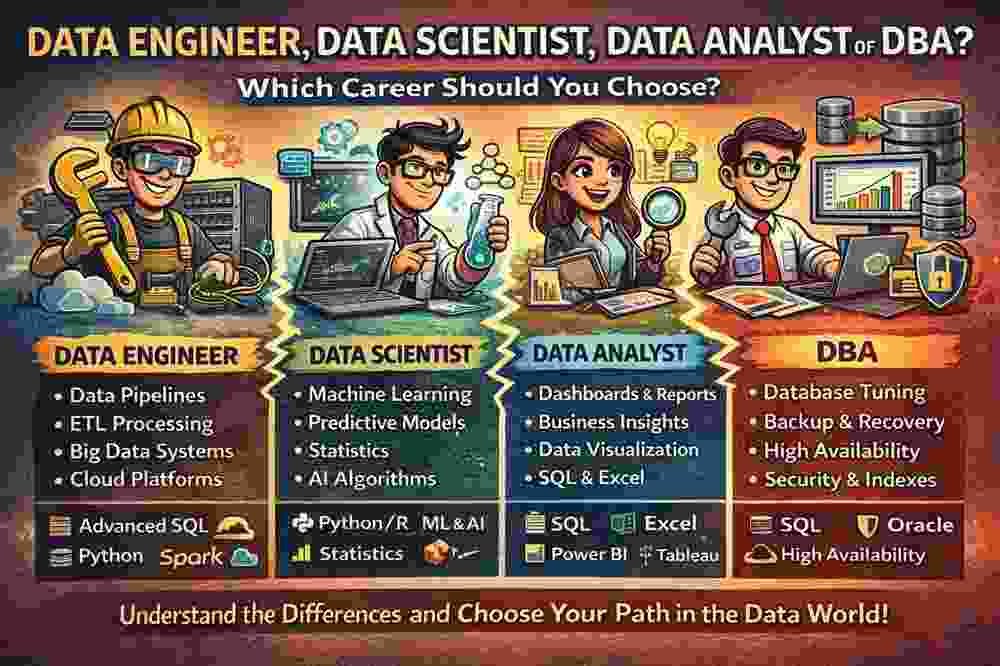
The world of data careers has exploded over the last decade.
Today we hear terms everywhere such as:
- Data Engineering
- Data Science
- Analytics
- Artificial Intelligence
- Big Data
- Machine Learning
However, many professionals entering the field don’t clearly understand the fundamental differences between the main roles in the data ecosystem.
After more than 25 years working with databases, data architecture, and large-scale production environments, I have seen many people spend years studying something that ultimately did not match their interests, mindset, or career goals.
The truth is simple:
Each role in the data world solves a completely different type of problem.
Understanding these differences can save you years of frustration and help you build a much more strategic career path.
Let’s break down the four most common roles in modern data teams.
1. Data Engineer
The Data Engineer is responsible for building the data infrastructure that supports the entire data ecosystem.
If data scientists are researchers and analysts are decision interpreters, data engineers are the architects of the entire system that makes data usable.
Without solid data engineering, organizations quickly face problems such as:
- inconsistent data
- slow pipelines
- unreliable analytics
- broken dashboards
- incomplete datasets
Data engineers focus on making data available, scalable, and reliable.
Typical Responsibilities
- Building and maintaining data pipelines
- Integrating data from multiple systems
- Designing ETL and ELT workflows
- Managing data lakes and data warehouses
- Handling distributed data processing
- Ensuring data quality and reliability
Core Technologies
- Advanced SQL
- Python or Scala
- Apache Spark
- Kafka
- Airflow
- Data warehouse technologies
- Cloud platforms (AWS, Azure, GCP)
Market Reality
Data Engineering has become one of the most demanded roles in the entire data industry.
Many organizations initially hired only Data Scientists and later realized that without proper data engineering, their data initiatives simply collapse.
Advantages
- Very high demand in the market
- Strong technical depth
- Excellent salaries
Challenges
- Focus is often more on infrastructure than on business insights
- Complex distributed environments
- Large-scale system responsibilities
2. Data Scientist
The Data Scientist focuses on extracting deeper insights from data using statistics, machine learning, and predictive models.
While data engineers prepare the infrastructure and pipelines, the data scientist tries to answer questions such as:
- Which customers are likely to churn?
- Which products will sell more next quarter?
- How can we detect fraud automatically?
- How can we optimize pricing strategies?
This role is heavily focused on mathematics, statistics, and experimentation.
Typical Responsibilities
- Developing predictive models
- Machine learning implementation
- Statistical analysis
- Feature engineering
- Experimentation and hypothesis testing
Core Technologies
- Python
- R
- SQL
- Pandas
- Scikit-learn
- TensorFlow
- PyTorch
Market Reality
Data Science is one of the most attractive roles, but also one of the most misunderstood.
Many professionals want to become data scientists, but relatively few truly master the mathematics and statistical reasoning required to excel in the field.
Advantages
- High intellectual challenge
- Strong business impact
- Excellent compensation in many markets
Challenges
- Requires strong mathematical background
- Highly competitive field
- Continuous learning is mandatory
3. Data Analyst
The Data Analyst focuses on transforming data into clear insights that business leaders can use to make decisions.
This role sits closer to the business side of the organization.
Data analysts are responsible for answering questions like:
- What happened last quarter?
- Which products are performing best?
- Which region has the highest sales growth?
- Where are operational inefficiencies occurring?
They transform raw data into dashboards, reports, and actionable insights.
Typical Responsibilities
- Creating dashboards
- Building reports
- Performing exploratory data analysis
- Supporting business decisions
- Presenting data-driven insights
Core Technologies
- SQL
- Excel
- Power BI
- Tableau
- Business intelligence tools
Additional useful skills include:
- Python
- R
- basic statistics
- data storytelling
Market Reality
Data analysts are needed across almost every industry.
Many professionals start their data careers as analysts before specializing further.
Advantages
- Lower barrier to entry compared to other roles
- Strong business visibility
- Broad applicability across industries
Challenges
- Less technical depth compared to engineering roles
- Salary growth may be slower in some markets
4. DBA (Database Administrator)
The Database Administrator (DBA) is responsible for ensuring that the entire data infrastructure remains reliable, secure, and performant.
In many mission-critical industries such as banking, healthcare, logistics, and finance, the DBA is the professional responsible for ensuring that systems simply never fail.
This role focuses deeply on the foundations of data systems.
Typical Responsibilities
- Database performance tuning
- Query optimization
- Index management
- Backup and recovery strategies
- Security configuration
- High availability architectures
- Disaster recovery planning
Technologies Commonly Used
- SQL Server
- Oracle
- PostgreSQL
- MySQL
- Replication technologies
- Clustering
- Always On / high availability solutions
Market Reality
Although the DBA role has evolved significantly with cloud platforms and automation, it remains essential in enterprise environments.
Many experienced DBAs eventually transition into roles such as:
- Database Architect
- Data Platform Architect
- Cloud Database Specialist
Advantages
- Deep technical expertise
- Critical role in enterprise environments
- Strong long-term career stability
Challenges
- Often reactive due to production incidents
- Less direct involvement with business analytics
The Reality: These Careers Often Interconnect
One important point many people overlook is that these roles are not isolated career paths.
Transitions between them happen frequently.
For example:
- A DBA can evolve into a Data Engineer
- A Data Analyst can become a Data Scientist
- A Data Engineer can become a Data Architect
The data ecosystem is interconnected, and professionals often evolve over time as they gain experience.
Final Advice After 25 Years Working with Data
After decades working in databases and data platforms, there is one piece of advice I give to every professional entering the data world:
Learn the business domain you are working in.
Many professionals focus exclusively on technology, algorithms, or tools.
But the professionals who truly stand out are those who understand:
- how the company makes money
- how the business operates
- which metrics actually matter
- what problems the organization is trying to solve
A great data professional does not only know how to write SQL queries or build pipelines.
They understand why the data exists and what business decisions depend on it.
Developing strong business understanding will make you far more valuable than simply mastering another tool or framework.
In the end, technology changes every few years.
But professionals who combine technical expertise with deep business understanding will always remain highly valuable.
🚀 Ready to boost your career in data?
👉 DBAcademy – DBA & Data Analyst Training
Over 1,300 lessons and 412 hours of exclusive content.
Includes subtitles in English, Spanish, and French.
🔗 https://filiado.wixsite.com/dbacademy
💡 Start learning today and become a highly in-demand data professional.
Share this content:




Post Comment