Data Engineer, Data Scientist, Data Analyst or DBA: Which Career Should You Choose?
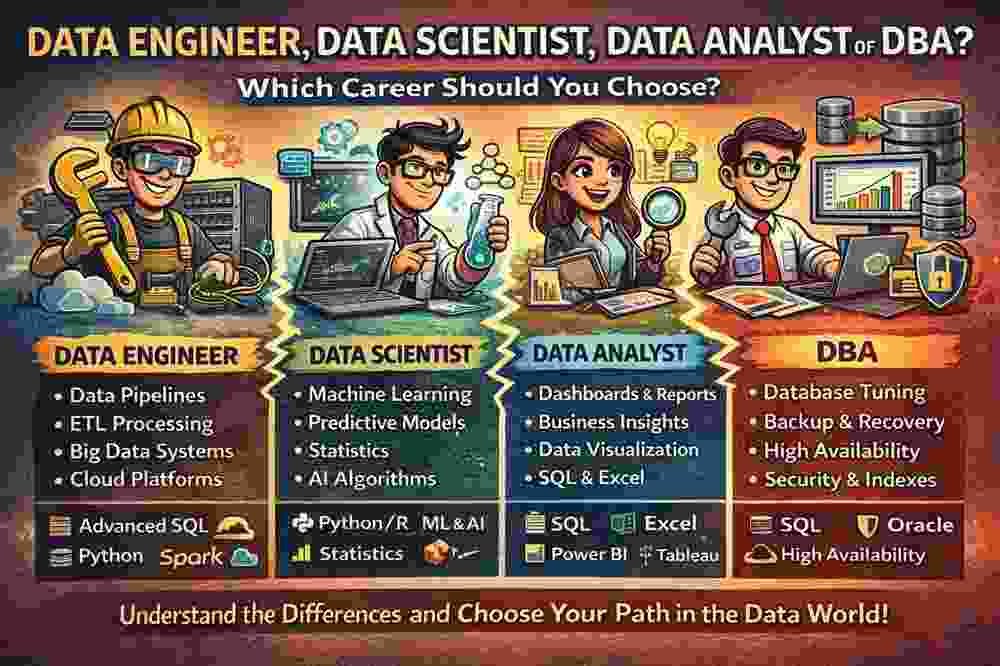
Choosing between becoming a Data Engineer, Data Scientist, Data Analyst, or DBA depends on several factors, including your personal interests, technical skills, career goals, and the job market where you intend to work.
The modern data ecosystem has grown significantly over the last decade. Organizations today rely heavily on data to drive business decisions, build predictive models, optimize operations, and develop new products.
However, many professionals entering the field are often confused about the real differences between these roles. While they all work with data, each role focuses on different responsibilities, technologies, and types of problems.
Understanding these differences can help you make a much more strategic career decision.
Let’s analyze each role.
Data Engineer
A Data Engineer focuses on building and maintaining the infrastructure that allows data to be collected, stored, processed, and made available for analysis.
Without data engineers, companies would struggle to organize large volumes of information and make it accessible to analysts and data scientists.
Responsibilities
- Building data pipelines to integrate, transform, and load data from multiple systems
- Designing and managing ETL/ELT processes
- Working with databases, data lakes, and distributed systems
- Ensuring that data is reliable, structured, and accessible
- Supporting analytics and machine learning environments
Required Skills
- Advanced SQL
- Python or Scala
- Big Data frameworks such as Hadoop and Spark
- Cloud platforms like AWS, Azure, or Google Cloud
- Data modeling and distributed system concepts
Market Demand
Data Engineers are currently in very high demand, especially in companies that process large volumes of data or are building modern data platforms.
Pros
- High salaries
- Strong technical challenges
- High demand across industries
Cons
- Focus on infrastructure rather than direct data analysis
- Often requires dealing with complex systems and pipelines
Data Scientist
A Data Scientist focuses on extracting deeper insights from data by using statistics, machine learning, and predictive modeling.
While Data Engineers prepare and structure the data, Data Scientists analyze it to identify patterns, make predictions, and support strategic decisions.
Responsibilities
- Developing predictive models
- Applying machine learning and statistical techniques
- Analyzing complex datasets
- Building algorithms for forecasting or pattern detection
- Providing insights that support business decisions
Required Skills
- Python or R
- SQL
- Statistics and probability
- Machine learning and deep learning concepts
- Tools such as TensorFlow, PyTorch, and data visualization libraries
Market Demand
The demand for Data Scientists is high, but the field is also very competitive, as it requires a combination of programming, statistics, and domain knowledge.
Pros
- Strong impact on business decisions
- Highly intellectual and challenging work
- Excellent salary potential
Cons
- Requires continuous learning
- Strong mathematical and statistical background needed
Data Analyst
A Data Analyst focuses on interpreting data and translating it into meaningful insights that help businesses make better decisions.
This role is usually closer to the business side of the organization.
Responsibilities
- Extracting and analyzing data
- Creating dashboards and reports
- Identifying trends and patterns
- Supporting business strategy and decision-making
Required Skills
- SQL
- Excel
- Power BI or Tableau
- Basic statistics
- Understanding of business processes
Basic knowledge of Python or R can also be helpful.
Market Demand
Data Analysts are needed across many industries, including finance, retail, healthcare, logistics, and technology.
Pros
- Lower barrier to entry compared to other data roles
- Wide range of opportunities across industries
- Strong connection with business operations
Cons
- Less technical depth compared to engineering or science roles
- Salaries can be lower than those of Data Engineers or Data Scientists
DBA (Database Administrator)
A Database Administrator (DBA) is responsible for managing, maintaining, and optimizing database systems.
DBAs ensure that data is stored securely, efficiently, and reliably while maintaining high system performance.
In many organizations, especially those with mission-critical systems such as banking, healthcare, and logistics, DBAs play a crucial role in ensuring that databases remain available and secure.
Responsibilities
- Database performance tuning
- Backup and recovery strategies
- Security and access control
- Index optimization
- High availability and disaster recovery
- Replication and storage management
Required Skills
- Advanced SQL
- Knowledge of database platforms such as SQL Server, Oracle, PostgreSQL, or MySQL
- Performance optimization techniques
- Security and infrastructure knowledge
Market Demand
The demand for experienced DBAs remains strong, particularly in organizations running critical enterprise systems.
Pros
- High technical specialization
- Stable and respected role in enterprise environments
- Opportunities to move into architecture roles
Cons
- Often focused more on infrastructure than analytics
- Market demand can vary depending on region and technology trends
How to Decide Which Career is Right for You
When choosing between these roles, consider the following questions.
What kind of problems do you enjoy solving?
If you enjoy building infrastructure and data pipelines, Data Engineering may be the best path.
If you enjoy statistics, algorithms, and predictive models, Data Science might be ideal.
If you enjoy analyzing information and presenting insights to businesses, Data Analytics could be a strong fit.
If you enjoy working deeply with database systems, performance tuning, and infrastructure, becoming a DBA may be the right direction.
Consider Your Long-Term Career Vision
Think about where you want to be in the next 5 to 10 years.
- Data Engineers often grow into Data Architects or Platform Architects
- Data Scientists can evolve into AI specialists or strategic leaders
- Data Analysts may specialize in business intelligence or transition into data science
- DBAs can evolve into Database Architects, Cloud Database Engineers, or Data Platform Engineers
Career Transitions Are Possible
Another important point is that these roles are not isolated.
Many professionals transition between them during their careers.
For example:
- A DBA can become a Data Engineer
- A Data Analyst can evolve into a Data Scientist
- A Data Engineer can move into data architecture
The skills between these roles often overlap.
Final Advice: Learn the Business
One of the most important lessons in any data career is this:
Understanding the business is just as important as understanding technology.
Many professionals focus heavily on tools, programming languages, and frameworks, but the most successful professionals in data are those who understand:
- how the company makes money
- what business problems need to be solved
- which metrics matter the most
- how data influences strategic decisions
When you combine technical skills with business understanding, you become far more valuable than someone who only knows the technology.
In the end, tools change quickly, but professionals who understand both data and business will always stand out.
Prof. Msc. Sandro Servino
Share this content:




Post Comment