“Data Careers Are a Bubble: Why Most ‘Data Professionals’ Are Solving the Wrong Problems”
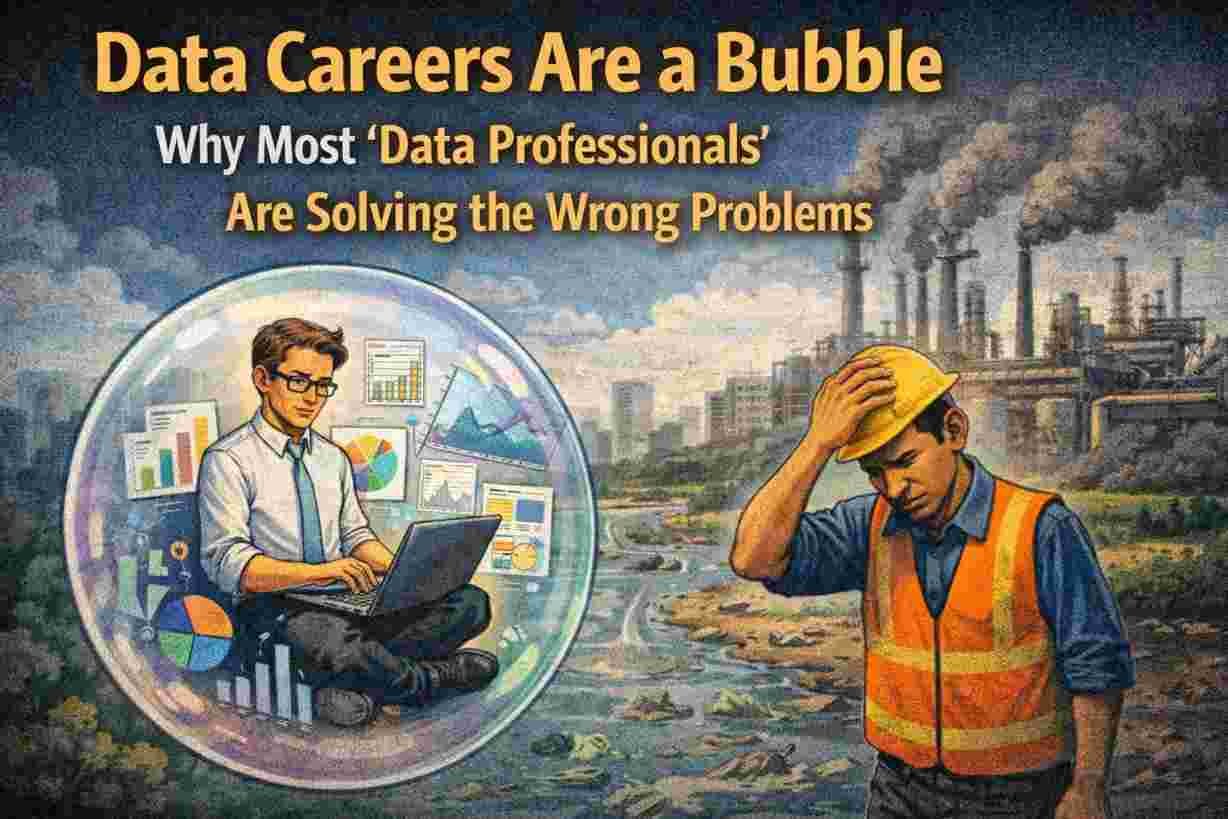
Introduction: the uncomfortable question no one wants to ask
Over the past decade, the field of data has been sold as the golden path of modern careers.
- “Data is the new oil.”
- “AI will change everything.”
- “Become a data scientist in 6 months.”
- “Six-figure salaries guaranteed.”
Entire industries have been built on top of this narrative.
Bootcamps.
Online courses.
Certifications.
Influencers.
LinkedIn posts full of dashboards and buzzwords.
And yet, if you talk privately to people inside companies — not in public posts, not in marketing materials, but in real conversations — a very different picture starts to emerge.
A picture full of:
- unused dashboards
- abandoned data projects
- misunderstood metrics
- overcomplicated pipelines
- frustrated stakeholders
Which leads to a question that feels almost heretical:
What if a large part of the data industry is solving problems that don’t actually matter?
The rise of the data profession: from necessity to hype
To understand where we are, we need to understand how we got here.
Data roles didn’t emerge out of hype.
They emerged out of necessity.
As companies digitized their operations, they started accumulating massive amounts of information:
- transactions
- user behavior
- logs
- operational metrics
At first, the challenge was simple:
“How do we store this?”
Then it evolved:
“How do we query this?”
And then:
“How do we use this to make decisions?”
That’s where roles like:
- Data Analyst
- Data Engineer
- Data Scientist
started to become essential.
But something changed around the mid-2010s.
The narrative shifted from:
👉 “Data is useful”
to:
👉 “Data will solve everything”
And that’s where the distortion began.
The problem with “data is the new oil”
The phrase sounds powerful.
But it’s also deeply misleading.
Oil has intrinsic value.
Data doesn’t.
Raw data is often:
- messy
- incomplete
- biased
- context-dependent
Without interpretation, data is just noise.
As Cathy O’Neil, author of Weapons of Math Destruction, argues, data-driven systems can often amplify bias rather than eliminate it.
As Nate Silver highlights in The Signal and the Noise, most data contains far more noise than signal — and extracting meaningful insights is far harder than it looks.
Yet the industry often behaves as if:
more data = more value
Which is simply not true.
The dashboard illusion
Let’s talk about one of the most visible outputs of data work:
Dashboards.
Every company has them.
Beautiful. Interactive. Colorful.
Full of:
- KPIs
- charts
- trends
- filters
They look impressive.
They feel productive.
But here’s the uncomfortable reality:
Most dashboards are rarely used after they are built.
This isn’t just anecdotal.
Multiple industry discussions (including reports from tools like Tableau and Looker communities) have highlighted that a large percentage of dashboards:
- are accessed only once or twice
- are not tied to real decisions
- exist mainly because “someone asked for them”
And yet, countless hours are spent building them.
Why?
Because dashboards are visible.
They create the illusion of impact.
Data work vs decision impact
There’s a critical distinction that is often ignored:
Producing data artifacts is not the same as influencing decisions.
You can:
- build a perfect pipeline
- create a clean dataset
- design a beautiful dashboard
And still have zero real-world impact.
Because impact happens when:
- someone changes behavior
- a decision is made differently
- a strategy is adjusted
And that requires more than technical skill.
It requires:
- context
- communication
- trust
- timing
As Harvard Business Review has repeatedly pointed out, data-driven organizations are not just those with more data — but those that integrate data into decision-making processes.
The overproduction of data professionals
Here’s where things get even more controversial.
The supply of data professionals has exploded.
Bootcamps promise fast transitions.
Courses promise quick mastery.
LinkedIn promotes constant upskilling.
But demand is more nuanced than it appears.
Companies don’t just need people who can:
- write SQL
- build models
- use Python
They need people who can:
- understand business problems
- define meaningful metrics
- communicate insights clearly
- influence decisions
And that’s a much rarer skill set.
This creates a mismatch:
Many people are trained for tools. Few are trained for impact.
The fragmentation of roles
The data field is also unusually fragmented.
You have:
- Data Analysts
- Data Scientists
- Data Engineers
- Analytics Engineers
- ML Engineers
- BI Developers
Each role has its own tools, expectations, and identity.
But in many companies, especially smaller ones, these boundaries blur.
One person ends up doing everything.
Or worse:
Multiple people work on disconnected parts of the same problem.
This fragmentation often leads to:
- duplicated work
- misaligned priorities
- unclear ownership
And ultimately:
less value delivered despite more people involved
The complexity trap
Modern data stacks are incredibly complex.
- data lakes
- warehouses
- orchestration tools
- streaming systems
- transformation layers
Each layer adds power.
But also adds friction.
In many cases, teams spend more time:
- maintaining pipelines
- fixing broken jobs
- managing dependencies
than actually generating insights.
As Martin Fowler has discussed in the context of software architecture, complexity is one of the biggest hidden costs in systems.
The same applies to data systems.
Complexity often grows faster than value.
The myth of the “data-driven company”
Many organizations claim to be “data-driven”.
But in reality, they are:
data-aware, not data-driven
They have data.
They collect data.
They display data.
But decisions are still made based on:
- intuition
- hierarchy
- politics
- urgency
And data is often used after the fact to justify decisions, not to guide them.
This phenomenon has been discussed in academic research on organizational behavior, where data is frequently used as a tool of persuasion rather than discovery.
The personal frustration of working in data
If you’ve worked in data for any amount of time, some of this may feel familiar.
You build something.
No one uses it.
You analyze something.
No action is taken.
You propose something.
It gets ignored.
Over time, this creates a subtle but powerful frustration:
“Does any of this actually matter?”
And that question is dangerous.
Because it leads to disengagement.
A personal perspective: what I’ve seen
In my own observation of the industry, one pattern repeats over and over:
The most valuable data professionals are not the most technical ones.
They are the ones who:
- ask better questions
- simplify problems
- focus on decisions, not outputs
- challenge assumptions
- connect data to reality
They often produce less “stuff”.
Fewer dashboards.
Fewer models.
Fewer pipelines.
But more impact.
The shift that needs to happen
If the data field is to mature, a shift is necessary.
From:
- tools → problems
- outputs → outcomes
- complexity → clarity
- volume → relevance
This is not easy.
Because the current system rewards visibility.
And visibility often comes from:
- building things
- showcasing tools
- demonstrating activity
Not necessarily from creating impact.
So… is the data career a bubble?
This is the provocative part.
I don’t think data careers are a “bubble” in the sense that they will disappear.
Data is too fundamental for that.
But I do think:
there is a bubble of expectations
A bubble of:
- inflated promises
- misunderstood roles
- superficial learning
- misplaced focus
And that bubble will correct over time.
What will remain valuable
When that correction happens, what will remain valuable are professionals who can:
- connect data to decisions
- reduce complexity
- communicate clearly
- understand context deeply
Not just those who know tools.
Advice for anyone in the field
If you are building a career in data, here’s the uncomfortable but honest advice:
- Stop focusing only on tools
Tools change. Problems remain. - Learn how decisions are made
That’s where your work gains meaning. - Prioritize clarity over sophistication
Simple insights that drive action beat complex models that don’t. - Get closer to the business
Distance kills relevance. - Measure your impact, not your output
What changed because of your work?
Final reflection
The data field is not broken.
But it is misaligned.
Between what is taught…
And what is needed.
Between what is built…
And what is used.
Between what is visible…
And what is valuable.
And maybe the most important question you can ask yourself is not:
“How can I become a better data professional?”
But:
“Am I solving problems that actually matter?”
Because in the end…
That’s the only thing that survives the hype.
🚀 Ready to boost your career in data?
👉 DBAcademy – DBA & Data Analyst Training
Over 1,300 lessons and 412 hours of exclusive content.
Includes subtitles in English, Spanish, and French.
🔗 https://filiado.wixsite.com/dbacademy
💡 Start learning today and become a highly in-demand data professional.
Share this content:



Post Comment