Microsoft SQL Server Certifications: Valuable, Yes — But Not What Truly Defines a Great Professional
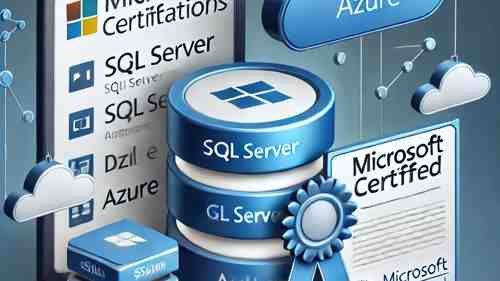
Over the years, I’ve seen thousands of professionals pursue Microsoft certifications for SQL Server and Azure.
Some passed exams with high scores.
Some collected multiple badges.
Some proudly displayed five, six, seven certifications on LinkedIn.
And yet…
When placed in a real production crisis, many struggled.
This article is not against certification.
But it is about perspective.
Because at the end of the day, knowledge builds careers — not certificates.
Why Certifications Exist — And Why They Matter
Let’s start with the positives.
Microsoft certifications such as:
- Azure Data Fundamentals (DP-900)
- Azure Database Administrator Associate (DP-300)
- Azure Solutions Architect Expert (AZ-305)
Serve important purposes.
They:
- Validate familiarity with official technologies
- Demonstrate structured study effort
- Provide international recognition
- Help junior professionals enter the market
- Force candidates to review best practices
- Create a baseline technical standard
For someone starting out, certification can absolutely open doors.
It shows commitment.
It shows discipline.
It shows initiative.
And globally, HR departments often use certifications as filtering mechanisms.
That’s reality.
The Hidden Problem: Certification ≠ Competence
Here’s where things get uncomfortable.
Passing an exam does not mean you can:
- Recover a corrupted database at 3 AM
- Diagnose blocking issues under pressure
- Design a resilient HA architecture
- Handle a 2TB migration
- Solve real-world performance problems
- Make architectural trade-offs under business constraints
Exams measure knowledge recall and conceptual understanding.
Production measures judgment.
Experience measures resilience.
Architecture measures vision.
Those are different dimensions.
The Certification Industry Effect
Globally, the tech industry has created a certification culture.
Companies list requirements like:
“DP-300 required.”
“Azure certification mandatory.”
“Solutions Architect Expert preferred.”
But rarely do they say:
“Must have handled real production incidents.”
“Must have led database recovery scenarios.”
“Must understand business impact of downtime.”
Because those things are harder to quantify.
So certificates become shortcuts.
But shortcuts can be misleading.
The Pros of Pursuing Microsoft Certifications
Let me be fair.
Certifications can be extremely beneficial when:
1. You Are Starting Your Career
They provide structure and direction.
2. You Want to Transition to Cloud
They force you to understand Azure concepts properly.
3. You Need International Recognition
For immigration or global opportunities, certifications help.
4. You Lack Formal Academic Background
Certifications can compensate for missing credentials.
5. You Want to Organize Your Knowledge
Studying for exams exposes gaps in understanding.
I’ve recommended certifications to many students.
But I always tell them the same thing:
Do not confuse the map with the territory.
The Cons — What People Don’t Talk About
Here’s the part most marketing materials ignore.
Certifications can:
- Create false confidence
- Encourage memorization instead of understanding
- Focus on exam tricks rather than architecture depth
- Become outdated quickly
- Give companies lazy hiring filters
- Shift focus away from real-world problem-solving
And in some cases, professionals become “certificate collectors” instead of builders.
That is dangerous.
The Real Question: What Actually Makes a Strong SQL Professional?
In my experience, what truly differentiates professionals is:
- Deep understanding of database internals
- Real incident exposure
- Architectural thinking
- Business awareness
- Ability to communicate technical decisions
- Continuous hands-on experimentation
- Curiosity beyond exam content
The best DBAs I know are not always the most certified.
They are the most experienced.
They have scars.
They have lessons learned.
They have failed — and recovered systems.
That builds competence.
Companies Need to Rethink Hiring
This is where I become more direct.
Companies should improve how they hire.
Instead of filtering candidates primarily by certification, they should:
- Conduct technical scenario-based interviews
- Present real incident case studies
- Test troubleshooting reasoning live
- Evaluate architectural decision-making
- Ask candidates to explain trade-offs
- Analyze problem-solving depth
A candidate who can:
Explain how to resolve a blocking storm.
Design a failover strategy.
Optimize a poorly indexed 800-million-row table.
Handle parameter sniffing in legacy systems.
Is far more valuable than someone who simply passed DP-300.
Certifications are indicators.
They are not proof of mastery.
The Long-Term Career Perspective
Technology changes.
Exam codes change.
Certification names change.
Cloud services evolve.
But core knowledge remains:
- How transactions work
- How indexing works
- How concurrency behaves
- How storage impacts performance
- How replication affects consistency
- How architecture affects business continuity
If you focus on fundamentals, you stay relevant.
If you focus only on exams, you expire with the exam version.
My Advice to Professionals Worldwide
If you are pursuing Microsoft certifications:
Do it.
But do it wisely.
Use certification as:
- A learning framework
- A credibility boost
- A career accelerator
Not as your identity.
Spend more time:
- Breaking lab environments
- Simulating disasters
- Testing recovery procedures
- Studying query execution plans
- Practicing migration scenarios
- Understanding internals
Real knowledge compounds.
Certificates expire.
Final Thoughts
Are Microsoft SQL Server certifications valuable?
Yes.
Are they essential for career growth?
Sometimes.
Are they proof of true expertise?
No.
At the end of the day, what defines your career is not the badge on your profile.
It is your ability to solve problems when things go wrong.
And things always go wrong.
Companies should learn to hire for depth, not decoration.
Professionals should aim for mastery, not only validation.
Because in the real world, production does not ask for your certificate.
It asks for your competence.
🚀 Ready to boost your career in data?
👉 DBAcademy – DBA & Data Analyst Training
Over 1,300 lessons and 412 hours of exclusive content.
Includes subtitles in English, Spanish, and French.
🔗 https://filiado.wixsite.com/dbacademy
💡 Start learning today and become a highly in-demand data professional.
Share this content:



Post Comment