Protecting cloud data stores: preventing misconfigurations, identity gaps and ai-driven exfiltration
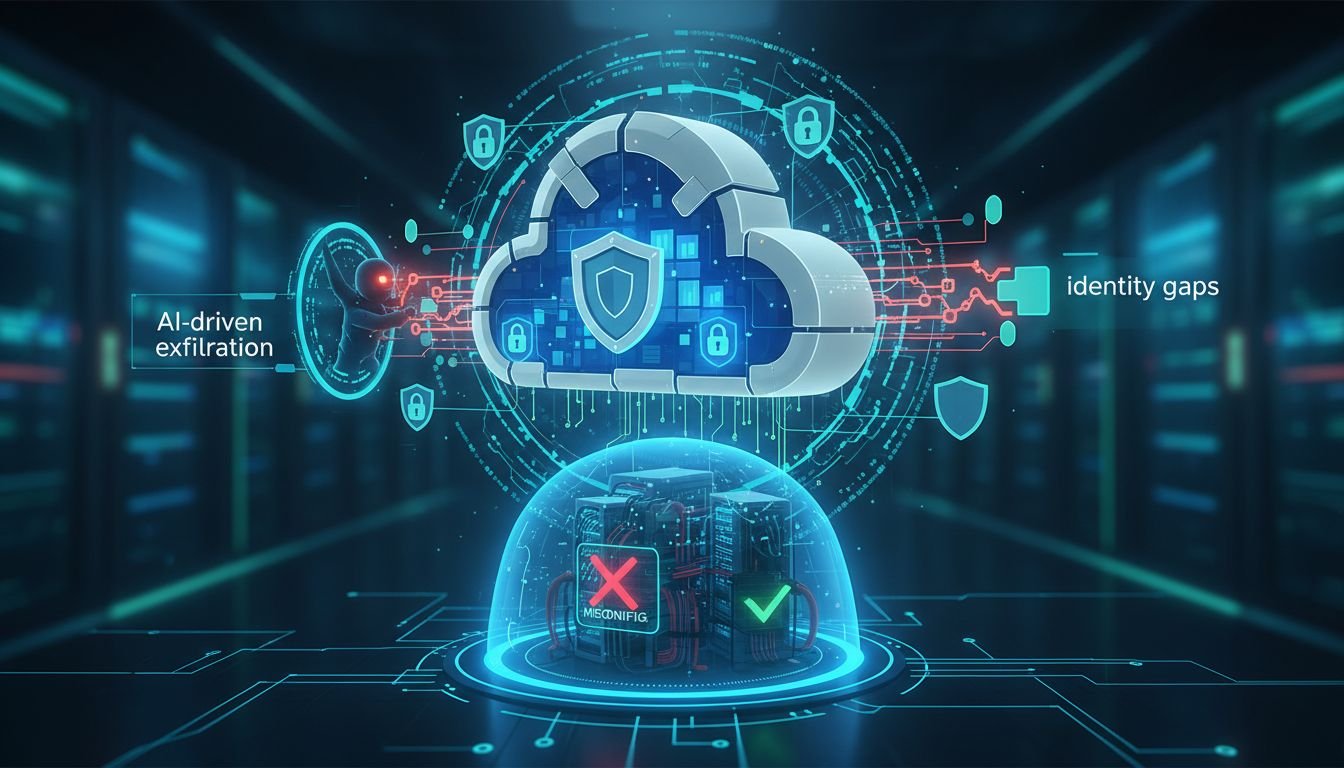
Cloud data stores are still being lost to boring failures dressed up as advanced threats. Open buckets, public snapshots, stale IAM roles, unmanaged service accounts, disabled logs, unrestricted egress, and notebook identities with far too much access remain common in production. What changed is the speed and camouflage of the attack chain. In 2026, defenders are dealing with adversaries that move through endpoint, identity, SaaS, and cloud environments using valid credentials and trusted workflows, then use AI to accelerate phishing, automate intrusion steps, and blend exfiltration into legitimate application behavior.
The evidence is no longer soft or speculative. CrowdStrike says the average eCrime breakout time in 2025 fell to 29 minutes, with the fastest observed breakout at 27 seconds, while AI-enabled adversaries increased operations by 89% year over year. Microsoft’s framing is blunt: threat actors are “turning to AI to scale phishing and automate intrusions,” and defenders must answer with “AI, automation, and secure-by-default practices.” If you run databases, object stores, analytics platforms, or managed AI services in cloud environments, protecting cloud data stores now means treating misconfiguration, identity, runtime telemetry, and AI governance as one operational problem.
Misconfiguration is still the cheapest path to expensive data loss
Most cloud data exposures do not begin with zero-days. They begin with teams moving too fast, copying bad templates, inheriting defaults, and assuming managed services are secure enough by construction. Palo Alto Networks tied rising cloud risk to a finding that 71% of organizations attribute increased vulnerability exposures to accelerated deployments. That matters because accelerated delivery is exactly how open storage, weak network boundaries, permissive IAM, and unreviewed service integrations make it into production.
CrowdStrike’s recurring cloud misconfiguration patterns are painfully familiar to anyone who has worked in real estates rather than vendor slide decks: excessive account permissions, ineffective identity architecture, disabled logging, missing alerts, open databases, caches and storage buckets, public snapshots and images, and unrestricted outbound access. Every one of those failures maps directly to data-store compromise. Public exposure leaks data outright. Overprivilege turns one compromised principal into broad read access. Missing telemetry delays detection until the data is already gone.
DBAs and data engineers should stop treating posture findings as cosmetic compliance debt. A storage bucket that should never be public is not a medium-priority hygiene item. A snapshot copied into the wrong account is not an administrative nuisance. Unrestricted outbound access from a database subnet is not a networking detail. These are direct exfiltration enablers. If your environment allows sensitive repositories to be exposed, copied, or queried without tight policy and alerting, the attacker does not need to be clever. They need you to stay undisciplined.
Identity gaps are the real control-plane breach path
Identity is not just a security layer wrapped around cloud infrastructure anymore. It is the attack path. CrowdStrike reported that 35% of cloud incidents in the first half of 2024 stemmed from valid account abuse. Google Cloud and Mandiant add that stolen credentials became the second most common initial infection vector in 2024 at 16%. If you are still talking about identity as if it were merely an access-management administrative function, you are behind the threat model.
The practical failure mode is straightforward. Organizations leave user accounts outside a single identity provider, fail to enforce MFA consistently, permit long-lived sessions, tolerate weak service-account governance, and accumulate dormant or duplicated access paths. CrowdStrike explicitly points to user accounts not rooted in one identity provider enforcing limited session times and MFA as a contributor to cloud data breaches. In plain terms, fragmented identity architecture creates holes attackers can use to reach cloud control planes and then your data stores.
This is where many infrastructure teams fool themselves. They lock down network ingress to databases and congratulate each other while privileged cloud identities still have broad API access to snapshots, object stores, backup vaults, key material, or analytics exports. Attackers do not need direct TCP access to your database listener if they can assume a role, mint a token, create an app, query an API, or export data through a sanctioned workflow. The modern perimeter around cloud data stores is identity, and in many estates it is poorly designed, weakly monitored, and over-trusted.
Unsecured repositories are still handing attackers both data and credentials
One of the more uncomfortable truths in recent incident reporting is that unsecured repositories remain an active source of compromise. Mandiant states plainly that attackers are “targeting unsecured data repositories to obtain credentials and other sensitive information.” That line should hit database teams especially hard, because it means repositories are not just end targets for theft. They are also stepping stones. A carelessly exposed store can contain access keys, connection strings, secrets in exports, customer data, internal documents, or model artifacts that enable the next stage of intrusion.
That should change how you classify repository risk. A misconfigured object store containing application backups is not only a confidentiality problem. It can become an identity problem when those backups include environment files, credential dumps, access tokens, private keys, or service endpoints. A public analytics dump is not only a privacy event. It can reveal internal schemas, naming conventions, user accounts, and operational patterns that make follow-on access easier. Storage posture and credential hygiene are intertwined, whether teams admit it or not.
Production-grade defense means continuous discovery of repositories, strict ownership tagging, default-deny public exposure, encryption and key separation where appropriate, secret scanning across stored artifacts, and aggressive retention discipline. Backups, snapshots, exports, logs, notebook volumes, and staging buckets all count. Too many organizations secure the flagship database while ignoring the copies, derivatives, and side channels around it. Attackers do not share that blind spot. They will take the cheapest repository that contains the fastest route to data or credentials.
Runtime telemetry and posture management must be one system
Cloud defense guidance is finally catching up to reality. Unit 42 reported that the most significant increase in its 2024 cloud alerts was in high-severity alerts, up 235%, and argued that “both cloud posture management and runtime security monitoring must function as a single unit.” That is not a marketing slogan. It is a hard requirement for defending IAM-centric attacks and exfiltration in environments where the control plane itself is part of the blast radius.
Posture tooling tells you what is possible. Runtime telemetry tells you what is happening. If you separate them organizationally or technically, you miss the attack chain. An overprivileged role looks like a policy issue until it starts listing buckets at unusual hours. A service account attached to a notebook looks benign until it begins reading datasets outside its expected project boundary. Egress permissiveness looks theoretical until a large transfer leaves through a legitimate API path. Defenders need policy state, identity graph, data-store inventory, network flow, and application telemetry correlated in near real time.
For data platforms, this means building detections around behavior, not just static misconfigurations. Alert when snapshots are shared cross-account. Alert when backup exports are created outside maintenance windows. Alert on first-time access to sensitive repositories by a principal, app, or region. Alert when database service identities call unrelated AI or SaaS APIs. If your monitoring cannot connect a bad configuration to suspicious use of that configuration, then you are collecting evidence for the postmortem, not preventing exfiltration.
AI services are importing default risk directly into cloud data environments
Managed AI adoption is now large enough that AI-specific governance is a core data-protection issue, not a side project for innovation teams. Tenable reports that 60% of Azure users have configured Cognitive Services, 25% of AWS users have configured Amazon SageMaker, and 20% of GCP users have configured Vertex AI Workbench. Once those services are wired into storage, databases, notebooks, and pipelines, their defaults and identity models become part of your cloud data-store threat surface.
The risk is not abstract. Tenable’s Cloud AI Risk Report 2025 says 70% of cloud workloads with AI software installed have a critical vulnerability, versus 50% of cloud workloads without AI software installed. It also warns that “Jenga-style layering of services by cloud providers can lead to inherited risky defaults, with serious implications if exploited, especially in AI environments.” That is exactly the kind of language experienced operators should take seriously, because inherited defaults are how dangerous access appears in production while everyone insists they never explicitly approved it.
The practical lesson is simple: every AI service touching your data stores needs inventory, policy baselines, identity review, egress review, and data-handling review before broad adoption. Do not assume managed notebooks, vector stores, model endpoints, or data connectors are safe because they are branded as managed. If they can read from object storage, query a warehouse, mount a dataset, stream a response, or call external services, they can also become exfiltration paths unless tightly constrained.
Overprivileged notebooks and risky defaults are already in production
Two Tenable findings should make cloud and database teams uncomfortable because they expose how normal bad practice has become. First, 77% of organizations using Google Cloud Vertex AI notebooks have at least one instance configured with the overprivileged default Compute Engine service account. Second, 91% of organizations using Amazon SageMaker have at least one notebook instance with the risky default of root access enabled. These are not edge cases. They are common production conditions.
Why does this matter for protecting cloud data stores? Because notebooks sit close to data. They are often granted broad read access for convenience, used interactively by humans, filled with packages and credentials, and connected to storage, warehouses, and model services. Give a notebook an overprivileged identity and you create an easy lateral-movement bridge between experimentation and production data. Leave root enabled and you expand what an attacker can do after compromise, including tampering with local artifacts, installing tooling, harvesting tokens, and staging exfiltration.
Teams should respond with boring discipline: dedicated service accounts per notebook class, no default compute identities, no root unless there is a documented exception, short-lived credentials, private networking, restrictive egress, immutable base images, and aggressive shutdown of idle instances. Most importantly, notebook access should map to the minimum datasets required for the work. If your ML platform can browse half the estate because “data scientists need flexibility,” then your AI environment is now a privileged data extraction environment waiting for a credential theft event.
AI-driven exfiltration is not theory anymore
The phrase AI-driven exfiltration is easy to overhype, but recent evidence supports a narrow, practical reading of it. Attackers are using AI to accelerate credential theft, automate steps in intrusion, and abuse trusted AI-connected workflows as data exits. CrowdStrike says that in 2025 adversaries exploited legitimate GenAI tools at more than 90 organizations by injecting malicious prompts to generate commands for stealing credentials and cryptocurrency. That should end the lazy assumption that AI tools are only passive assistants. In the wrong workflow, they become operational force multipliers for theft.
Palo Alto Networks’ State of Cloud Security Report 2025 goes further, saying 47% of AI system breaches involved data exfiltration through assistants or plugins. Given that the report draws from more than 2,800 security leaders and practitioners across 10 countries, this is not a fringe anecdote. It reflects a maturing failure pattern: organizations connect assistants, plugins, notebooks, model endpoints, and external tools to sensitive repositories before they have established hard boundaries on what data can be read, transformed, or sent out.
For defenders, the implication is clear. You need explicit controls on AI app-to-data-store pathways: connector allowlists, least-privilege scopes, content-aware egress inspection where feasible, approval workflows for new integrations, and logging that records exactly which principal, model, plugin, or application accessed which repository and sent what class of data where. If your AI stack can talk to your data stores and your logs cannot reconstruct that conversation, then you have built an exfiltration surface you cannot investigate properly.
Recent cases show how valid credentials and legitimate apps defeat weak governance
The Storm-2077 case is a useful reminder that attackers do not need flamboyant malware when cloud governance is weak. Microsoft assessed that the actor used valid credentials, harvested credentials from compromised endpoints, and successfully exfiltrated emails by stealing credentials to access legitimate cloud applications such as eDiscovery applications. In some cases, after gaining administrative access, it created its own application with mail read rights. That pattern should sound familiar to cloud data defenders: use identity abuse to turn trusted applications into sanctioned exfiltration channels.
Google’s recent advisories around Vertex AI also show why AI service governance now belongs in the same conversation as data-store protection. In bulletin GCP-2024-063, Google said a vulnerability in the Vertex AI API serving Gemini multimodal requests could allow bypass of VPC Service Controls, and that “An attacker may be able to abuse the fileURI parameter of the API to exfiltrate data.” In bulletin GCP-2025-059, Google disclosed that a technical issue in the Vertex AI API caused a limited amount of streaming responses to be misrouted between recipients for certain third-party models, though Google said its own Gemini models were not impacted.
The lesson is not that cloud AI is uniquely broken. The lesson is that legitimate cloud apps, service APIs, and managed AI features can all become data-leak channels under the right conditions. Valid credentials, broad app permissions, and weak segmentation make those channels usable. Sensible teams should therefore govern application consent, service-account scope, VPC and service perimeters, response handling, and outbound paths with the same seriousness they apply to database authentication and backup encryption.
What a defensible operating model actually looks like
Protecting cloud data stores requires a combined control set because the failure mode is combined: misconfigured or unsecured repositories create exposure, identity abuse and overprivileged defaults provide access, and AI tooling accelerates or disguises exfiltration across SaaS and cloud trust boundaries. That means your operating model must connect repository discovery, IAM hygiene, runtime telemetry, and AI governance instead of assigning each to different teams that barely speak to one another.
Start with a minimal standard that is non-negotiable. Every data store, snapshot, backup target, cache, and bucket must have an owner, classification, and approved access path. Every human and workload identity must be anchored to centralized identity controls with MFA, short sessions where possible, and elimination of unmanaged or duplicate accounts. Every managed AI service must have an inventory entry, a reviewed service identity, restricted data connectors, and explicit egress policy. Logging cannot be optional, and missing alerts around sensitive repositories should be treated as defects, not future improvements.
Then make it operational. Run continuous posture scans, but also test runtime detections with real scenarios: token theft, snapshot sharing, notebook abuse, plugin overreach, cross-project reads, and unusual export volume. Kill default identities. Remove root from managed notebooks. Block unrestricted outbound access where possible. Review app consents and service-account keys aggressively. If your environment can survive only when every team behaves perfectly, it is not secure. Production defense depends on guardrails that remain effective when people are rushed, distracted, undertrained, or wrong.
The current state of cloud security is not confusing. It is just uncomfortable. Misconfigurations remain common because delivery pressure is real. Identity gaps remain common because access sprawl is politically easier than cleanup. AI-driven exfiltration is rising because organizations keep wiring new services into old data without redesigning trust boundaries. None of this is mysterious. It is what happens when convenience beats architecture and architecture beats operations only on paper.
The fix is also not mysterious. Harden repository posture, centralize and reduce identity, unify posture with runtime monitoring, and apply strict governance to AI services before they touch production data. CrowdStrike, Mandiant, Microsoft, Palo Alto Networks, and Tenable are all pointing at the same reality from different angles. The teams that take the hint will reduce blast radius. The teams that keep calling these issues edge cases will keep learning about them from incident responders.
Share this content:



Post Comment