Why Many Developers Still Don’t Understand Databases
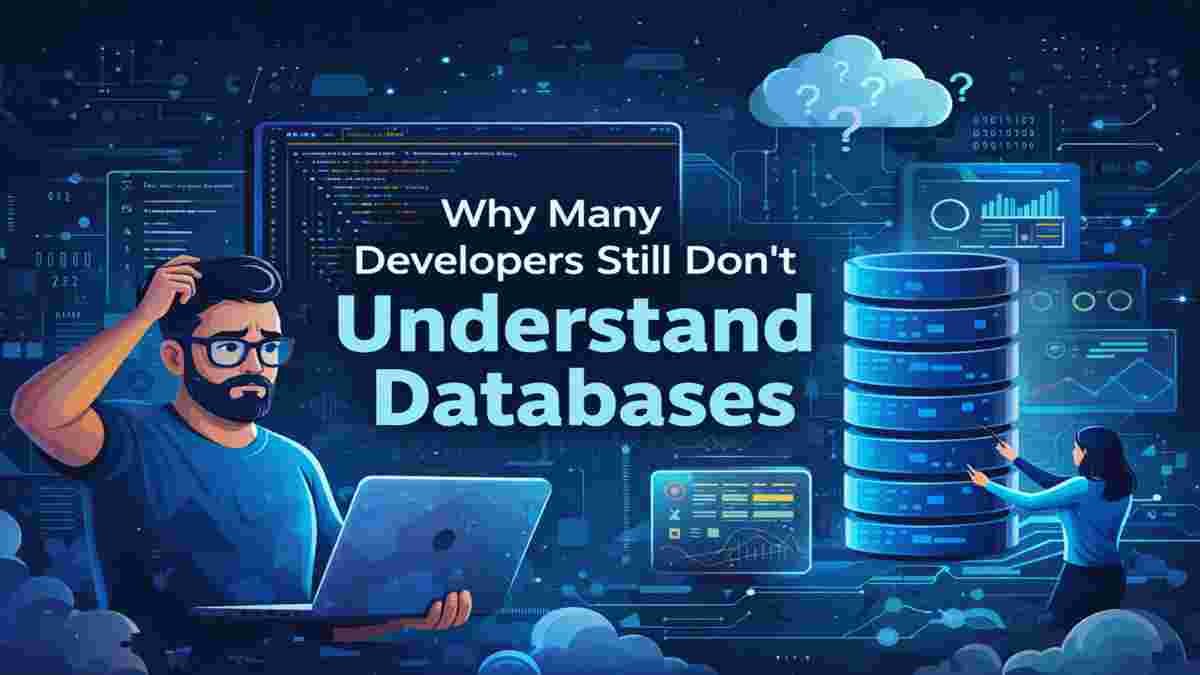
There is something I have noticed for many years, and it keeps repeating itself in company after company, project after project.
A lot of developers work with databases every day.
They write queries every day.
They depend on data every day.
And yet, many of them still do not truly understand databases.
I am not saying they are not intelligent. Far from it. Some of the smartest people I have met in technology were developers who could build impressive applications, design elegant APIs, and solve difficult business problems. But when the conversation moved into database behavior, query plans, locking, indexing, concurrency, data growth, and system pressure, the understanding often became shallow very quickly.
And this creates a serious problem.
Bad architecture may survive in the application layer for a while. Bad database decisions usually collect interest. And one day that interest is paid in production, with high CPU, blocked transactions, slow reports, unhappy users, emergency calls, and teams blaming each other.
So the question is not whether developers are capable of understanding databases.
The question is why so many of them never go deep enough.
The first reason: databases look easier than they are
This is probably the biggest trap.
A developer learns basic SQL early:
SELECT name, email
FROM customers
WHERE country = 'USA';
It works. It feels simple. It returns rows. It gives the impression that databases are straightforward.
And at a certain level, they are.
But real database work is not about returning ten rows from a development table with a few thousand records. Real database work starts when that same table has 400 million rows, dozens of indexes, concurrent transactions, changing statistics, skewed data distribution, maintenance windows, replication, backups, and business-critical workloads hitting it every second.
That is when the illusion breaks.
The syntax of SQL is not the hard part.
The hard part is understanding what the engine must do to produce that result under real conditions.
Many developers stop at the syntax layer.
Very few continue into the engine layer.
And that is exactly where the real value is.
The second reason: many developers are trained to think about code, not data behavior
Most developers are trained to think in terms of:
- classes
- services
- endpoints
- frameworks
- deployments
- business features
That is natural. It is their world.
But databases force a different kind of thinking.
A database does not care that your code is elegant if your query is inefficient.
It does not care that your API is modern if every request triggers a table scan.
It does not care that your microservices architecture looks beautiful on a slide if each service creates unnecessary round trips and data duplication.
Databases force you to think about:
- sets instead of loops
- cardinality instead of objects
- data distribution instead of assumptions
- concurrency instead of isolated execution
- physical reality instead of only logical design
This mental transition is harder than many people expect.
A lot of developers keep trying to use the database as if it were an object store with SQL on top. That is one of the reasons they get surprised when performance collapses.
The third reason: they rarely suffer enough early in their careers
That may sound harsh, but it is true.
Many developers only start respecting databases after they have lived through one or two painful incidents.
The first time a simple query melts a production server, something changes.
The first time a deployment introduces a missing filter and causes millions of unnecessary reads, something changes.
The first time a report blocks a transactional workload and the business starts shouting, something changes.
Pain is a very effective teacher in technology.
Before that pain happens, many developers assume the database will “figure it out.” They assume indexes are magic, the optimizer is perfect, and hardware will compensate for bad decisions.
Then reality arrives.
And reality usually arrives on a Friday, at the worst possible time.
The fourth reason: the database is often treated as someone else’s problem
In many companies, the culture silently teaches developers that the database belongs to the DBA, or to the platform team, or to “infrastructure.”
That division creates intellectual laziness.
Developers think:
- performance is the DBA’s job
- indexing is the DBA’s job
- deadlocks are the DBA’s job
- data growth is the DBA’s job
And then they write queries that create all those problems.
This model is broken.
A database is shared responsibility.
A DBA can help diagnose, optimize, and protect the environment. But if the application generates bad access patterns, poor filtering, unnecessary sorts, giant transactions, cursor-heavy logic, or query storms, the DBA is not performing magic. The DBA is doing damage control.
The strongest teams I have seen are not the ones where DBAs carry the entire database burden alone.
They are the teams where developers understand enough about databases to avoid creating preventable disasters.
The fifth reason: ORMs create false confidence
I am not anti-ORM. ORMs are useful. They accelerate development, standardize access patterns, and reduce repetitive coding.
But they also create a dangerous illusion.
A developer writes:
var orders = db.Orders.Where(x => x.CustomerId == id).ToList();
It looks clean. It feels harmless.
But under the hood, what is being generated?
- Is it using the right predicate?
- Is it pulling too many columns?
- Is it generating unnecessary joins?
- Is it issuing one query or fifty?
- Is it using pagination correctly?
- Is it causing parameter sniffing issues?
- Is it preventing index usage?
Many developers trust the abstraction too much. They stop thinking about the SQL being generated, and once that happens, they lose visibility into what the database is actually processing.
Abstractions are useful until they disconnect you from reality.
And databases punish disconnection from reality.
One of the biggest misunderstandings: “the database is slow”
I have heard this sentence more times than I can count.
“The database is slow.”
That sentence is often wrong.
Usually what people mean is:
- a query is inefficient
- the access pattern is wrong
- the data model is poor
- the indexes don’t support the workload
- statistics are misleading the optimizer
- concurrency is creating blocking
- the infrastructure cannot support the access pattern
The database is often doing exactly what it was told to do.
The real issue is that many developers do not understand what they asked the engine to do.
That distinction matters a lot.
Because if you think the database is randomly slow, you will look for random solutions.
If you understand that the engine is following rules, you can start reasoning clearly.
Example: a query that looks harmless but is not
Consider this:
SELECT *
FROM Orders
WHERE YEAR(OrderDate) = 2025;
Many developers see nothing wrong with it.
But if there is an index on OrderDate, this query may still perform terribly because the function on the column can prevent efficient index usage.
A more database-aware developer would write:
SELECT OrderId, CustomerId, OrderDate, TotalAmount
FROM Orders
WHERE OrderDate >= '2025-01-01'
  AND OrderDate <  '2026-01-01';
Now we have:
- no unnecessary
SELECT * - a sargable predicate
- better potential for index usage
- less data transfer
This is not about style.
This is about understanding how the engine thinks.
And that is exactly what many developers never study.
Another example: “it works in development”
This is one of the most dangerous sentences in software.
Of course it works in development.
Development has:
- small tables
- fewer users
- almost no concurrency
- no real data skew
- no true production pressure
Databases reveal their real personality under scale, contention, and imperfect data.
A query that returns in 40 milliseconds in development may take 12 seconds in production because:
- the table is 1000 times larger
- the statistics tell a different story
- the data distribution is uneven
- concurrent writes change locking behavior
- the chosen execution plan is no longer appropriate
Developers who do not understand databases often confuse functional correctness with operational correctness.
A query can be functionally correct and still be operationally catastrophic.
That is one of the most important lessons in database work.
Why developers struggle with execution plans
Execution plans are one of the clearest examples of the database knowledge gap.
Many developers either never open them or open them without knowing what they are seeing.
But execution plans tell an incredibly rich story:
- whether the engine is scanning or seeking
- how joins are being performed
- where sorts are happening
- where memory is being consumed
- where cardinality estimates are wrong
- where parallelism helps or hurts
- where the optimizer is making expensive decisions
To someone who understands them, execution plans are not just diagrams.
They are explanations.
And yet, many developers spend years writing database code without learning how to read the engine’s explanation of what it is doing.
That is like driving a car for years without learning what the warning lights mean.
Personal opinion: database ignorance is expensive arrogance
This is where I will be a little more direct.
In some environments, developers dismiss database concerns too quickly.
They think database professionals are being overly cautious.
They think indexing discussions are old-fashioned.
They think the cloud will solve scaling issues automatically.
They think modern frameworks remove the need to understand how data behaves.
This attitude is expensive.
Not immediately, sometimes. But eventually.
Eventually it becomes:
- cloud bills that grow for no good reason
- hardware upgrades that should never have been necessary
- slow releases because production is unstable
- analytics nobody trusts
- teams working harder to compensate for avoidable technical debt
The arrogance is not in not knowing.
The arrogance is in thinking you do not need to know.
Why this matters even more now
Ironically, modern technology makes database understanding even more important, not less.
Why?
Because systems are becoming more distributed, more integrated, and more data-heavy.
Now we have:
- microservices
- event-driven systems
- data lakes
- real-time analytics
- AI pipelines
- hybrid transactional and analytical workloads
All of this creates more data movement, more complexity, and more opportunities to misunderstand how data is stored, queried, transformed, and trusted.
The cost of misunderstanding databases is now spread across the entire company:
- engineering
- analytics
- reporting
- operations
- finance
- product decisions
So this is not just a backend concern anymore.
It is a company concern.
What developers should do differently
If a developer wants to become stronger in this area, the path is not mysterious.
They need to stop treating the database as a black box.
They should learn:
- basic indexing strategy
- how statistics influence plans
- why data distribution matters
- what makes a predicate sargable
- how transactions affect concurrency
- how to read execution plans
- what blocking and deadlocks actually mean
- why
SELECT *is often lazy engineering - when a big query should be broken into stages
- how data models influence everything downstream
They do not need to become full-time DBAs.
But they do need enough understanding to stop creating avoidable damage.
That alone already changes the quality of systems dramatically.
Final thought
Why do many developers still not understand databases?
Because databases are deceptively simple at the surface and brutally unforgiving underneath.
Because companies often separate application thinking from data thinking.
Because abstractions hide too much.
Because people are rewarded for shipping features faster, not for understanding the long-term behavior of data systems.
And because many only start learning seriously after they have already caused or witnessed pain.
But the developers who do take databases seriously become different professionals.
They design better systems.
They write safer queries.
They scale more intelligently.
They argue with more substance.
They create less technical debt.
And when things go wrong in production, they are much harder to fool — because they know where the truth usually lives.
It lives in the data.
🚀 Ready to boost your career in data?
👉 DBAcademy – DBA & Data Analyst Training
Over 1,300 lessons and 412 hours of exclusive content.
Includes subtitles in English, Spanish, and French.
🔗 https://filiado.wixsite.com/dbacademy
💡 Start learning today and become a highly in-demand data professional.
Share this content:



Post Comment